


 English
 Español
 عربى


Get Social
Choose DEIF for the perfect blend of
performance and aesthetics.
 Get Free Sample

Content
This article is written for engineering procurement teams, export traders, hotel and commercial contractors, and building materials distributors. It does not address residential consumer preferences. Its purpose is to help you evaluate technical risk, write enforceable specifications, and verify whether a manufacturer can deliver a large order consistently, legally, and on schedule.
Large flooring projects tend to fail for predictable reasons. Batch color variation drifts between shipments. Boards cup or crack when site humidity is not controlled. Export certificates do not cover the exact product model, so customs clearance stalls. Custom lead times slip, and grade terminology is misread at the quotation stage. Each of these problems is preventable when the buyer understands the technical baseline before signing.
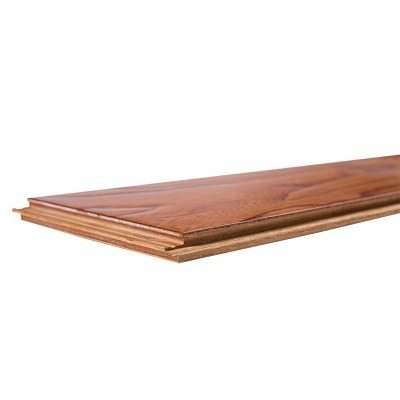
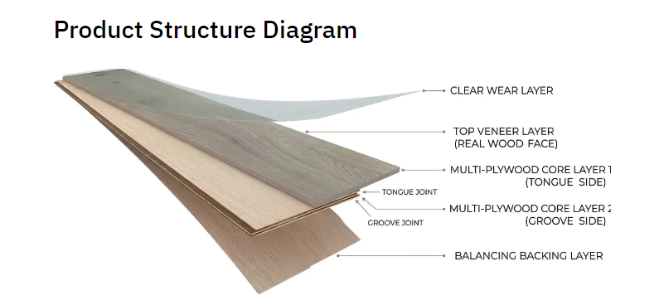
A multi-ply engineered flooring product is built from several thin veneer layers bonded under heat and pressure, with each layer rotated roughly 90 degrees from the one beneath it. This cross-grain arrangement is the core reason the product behaves more predictably than solid timber when humidity changes.
Solid wood expands and contracts most strongly across the grain. When each veneer layer runs in a different direction, the movement of one layer is restrained by the layers above and below it. The result is a board whose net dimensional change is far smaller than that of a single solid plank of the same species and thickness.
Substrate construction is one of the most important specification decisions. The table below summarizes how the two common configurations differ in practical project terms.
| Attribute | 3-Layer Build | 7-Layer Build |
|---|---|---|
| Typical core material | Fir or pine plywood core | Fir or pine multi-ply core |
| Dimensional stability | Good | Higher |
| Suitable board width | Standard to medium width | Wide plank formats |
| Underfloor heating suitability | Conditional | Strong candidate |
| Typical project use | Cost-controlled commercial areas | Premium residential and hospitality |
Specifications should describe measurable engineering behavior rather than subjective appearance. Three factors deserve explicit attention in any tender document.
Procurement teams need a fast way to narrow options against project requirements. The matrix below organizes the main variables: surface treatment, species family, grade, finish system, and locking method.
Clean, uniform appearance with the lowest visible wear mismatch over time. Suited to hotel rooms and corridors where consistency matters most. Scratches show more readily, so maintenance planning is important.
Raised grain texture that conceals light surface scratches and minor wear. Works well in high-traffic commercial spaces. Grain character varies more across a batch, which should be addressed in the grade clause.
Irregular, textured profile that offers strong visual depth and hides traffic marks effectively. Yield loss during conversion is higher, so budget planning should include a larger waste allowance.
| Finish System | Surface Hardness | Maintenance Method | Best Fit Scenario |
|---|---|---|---|
| UV Lacquer | High | Recoat at the factory or use hard coating system | High-traffic commercial areas |
| UV Oil | Moderate | Localized spot treatment | Residential and boutique hospitality |
| Hardwax Oil | Moderate | Periodic re-oiling in worn zones | Projects requiring a natural matte look and easy local repair |
Grade terms are not standardized across every market, so the buyer must define them in the contract. The table below explains what each grade generally represents and where it fits in budget planning.
| Grade | Knot Presence | Color Variation | Mineral Streak Range | Typical Budget Position |
|---|---|---|---|---|
| AB | Limited, mostly sound | Low | Minimal | Premium |
| ABC | Moderate, sound knots allowed | Moderate | Limited | Mid-range |
| ABCD | Higher, with character knots | Higher | Visible | Value-oriented |
| CD | Pronounced character features | Wide | Prominent | Economy |
Click-lock installation reduces on-site labor time and avoids adhesive curing delays, which matters on fast-track projects. Standard reference dimensions cover most residential and hospitality formats, while custom thickness, width, and length can be produced within the factory's stated range. Confirm the tolerance on each dimension in writing, because locking profile accuracy depends on consistent machining.
| Project Type | Recommended Surface | Finish | Grade Reference |
|---|---|---|---|
| Premium residential or villa | Smooth or wire-brushed | UV oil or hardwax oil | AB or ABC |
| Hotel guest rooms | Smooth | UV lacquer | ABC |
| Commercial public areas | Wire-brushed | UV lacquer | ABC or ABCD |
| Budget-controlled fit-out | Smooth or wire-brushed | UV lacquer | ABCD |
Specifications should follow the demands of the space. A flooring system that performs well in a villa may underperform in a lobby with heavy foot traffic and frequent cleaning. The following guidance outlines the priorities for each common project category.
Hotels prioritize batch consistency, because adjacent rooms and corridors must appear uniform when viewed together. Wear resistance is the second priority. Specify a lacquer system, a grade that limits color deviation, and a documented lot-matching procedure. Public corridors with rolling luggage traffic benefit from a wire-brushed surface and a harder finish.
Regional climate changes the risk profile significantly. The table below summarizes the key concerns for three common export markets.
| Market Climate | Primary Risk | Key Specification Focus |
|---|---|---|
| Cold and dry (northern North America) | Shrinkage and gapping in winter heating | Substrate stability, acclimation instructions, humidity guidance |
| Hot with large daily temperature swings (Middle East) | Surface stress and finish fatigue | Finish durability, UV resistance, expansion gap design |
| Humid coastal (northern Europe) | Edge swelling and moisture ingress | Moisture content at packing, sealed edge options, sub-floor moisture control |
Heated floors demand tight control of substrate construction and board moisture. Confirm that the product is rated for the intended surface temperature, that the board is acclimatized before installation, and that the heating system includes temperature limits. Floor boards alone cannot compensate for an improperly prepared heating slab.
Below-grade areas are high-risk for any wood-based flooring. Engineered products can perform in these spaces only when the sub-floor moisture is verified, a vapor barrier is installed, and the room humidity is controlled year-round. Where these conditions cannot be guaranteed, the specification should recommend an alternative material.
A large order depends on four capabilities: consistent production, legal export eligibility, reliable customization, and on-time delivery. The checklists below are designed to be sent to a supplier as a written questionnaire, so answers can be compared across bidders.
Export certification is the first gate. Request the documents for the exact product model and confirm each certificate's validity period. Common documents include CE marking, FSC chain-of-custody, CARB Phase 2 emission compliance, FloorScore indoor air quality, and ISO management system certification.
Certificates cover the specific product model being quoted, not a generic company document.
Validity dates extend through the planned shipment and installation period.
High-resolution electronic copies are available for customs clearance.
Test reports can be matched to the batch or production period.
Sample quality is easy to achieve. Bulk consistency is the real test. Ask the factory to describe its production line, its moisture control method, and its batch sampling procedure.
| Process Stage | What to Verify |
|---|---|
| Raw material screening | Species and veneer sourcing controls, defect rejection rules |
| Substrate moisture control | Target moisture range, measurement frequency, drying records |
| Hot-press lamination | Adhesive type, pressure and temperature logs |
| Surface processing | Brushing or scraping consistency, sanding control |
| Finish application | Coating thickness, curing verification |
| Grading and batch sampling | Grade sorting records, color deviation checks per lot |
Send the factory the following questions in writing and file the answers with the bid package.
Customization can include dimensions, veneer color adjustment, surface treatment, finish type, and grade combinations. Each change should be confirmed against minimum order quantity, sampling lead time, and the color tolerance standard that applies to bulk production.
Ask for annual capacity figures, available warehouse stock, and standard versus custom lead times. Confirm how peak-season demand affects scheduling. Export support should include packing specifications, carton marking, and complete shipping documentation.
Copy this list into your internal review file.
Product-specific certificates provided and valid through shipment date
Production line description and quality control flow received in writing
Batch color control method and sampling records requested
Third-party test reports available per batch
Defect handling procedure documented
Custom MOQ, sample lead time, and color tolerance confirmed
Annual capacity and peak-season lead time stated
Packing and shipping documents supported
A structured workflow reduces back-and-forth and protects the project timeline. The process below moves from initial inquiry through sampling, approval, production, and receiving inspection.
Provide the factory with complete project data so quotations are comparable. Include floor area, destination market, species and surface treatment, grade, finish, dimensions, heating requirement, and the certificates the project needs.
Request physical samples and color boards. Confirm the sampling lead time and the fee policy before approving the sample round, and record the number of revision cycles allowed.
An approved sample becomes the benchmark for bulk acceptance. Seal the approved sample, retain a reference set, and record the agreed grade, color deviation range, and surface features in writing. Without this step, acceptance disputes become a matter of memory.
Write the specification, grade standard, and certificate requirements into the purchase contract. During production, request progress photos, pre-shipment sampling results, and a packing inspection report before the goods leave the factory.
The questions below reflect issues that commonly arise during specification reviews and supplier negotiations.
Not automatically. Layer count contributes to stability, but adhesive quality, core density, and drying control at the factory are equally important. A well-made lower-count product can outperform a poorly controlled higher-count one.
No. Cross-grain construction reduces movement substantially but does not eliminate it. Specifications should set acceptable tolerances and installation conditions rather than promise zero dimensional change.
Higher grades carry a meaningful price premium because they require more sorting and yield more waste. Balance the budget by assigning higher grades to high-visibility zones and lower grades to back-of-house or lower-traffic areas within the same project.
European projects commonly require CE documentation and FSC chain-of-custody evidence. North American projects often require CARB Phase 2 compliance and may require FloorScore for indoor air quality. Confirm the exact requirements with the importing authority and the project specifier before production begins.
These values vary by factory and by customization type. Request both figures in writing, along with the numerical color deviation limit that will be applied during bulk acceptance.
No. Product certification confirms material performance, but heating success also depends on slab preparation, moisture levels, temperature control, and acclimatization. The sub-floor condition is as critical as the board itself.
Yes, when the specification matches the traffic level. Select a harder finish, a grade with controlled variation, and a substrate suited to the load. Confirm installation method and maintenance requirements with the supplier.
Once you have shortlisted candidates, the most efficient next step is to prepare a complete project brief and request documentation. Ask for a technical specification sheet, submit your project requirements for a selection recommendation, and request physical samples and color boards for side-by-side comparison.
Request a technical data package, submit your project specification for review, or ask for a certification bundle covering your target market.

We provide customers with sustainable and eco-friendly
engineered wood solutions and services.
Choose DEIF for the perfect blend of
performance and aesthetics.
