Choosing solid wood flooring is a structural decision as much as a design one. Because a single plank runs full-thickness from wear layer to subfloor, the material you select today determines how many decades a building can go before its floors need replacing.
What Is Solid Wood Flooring?
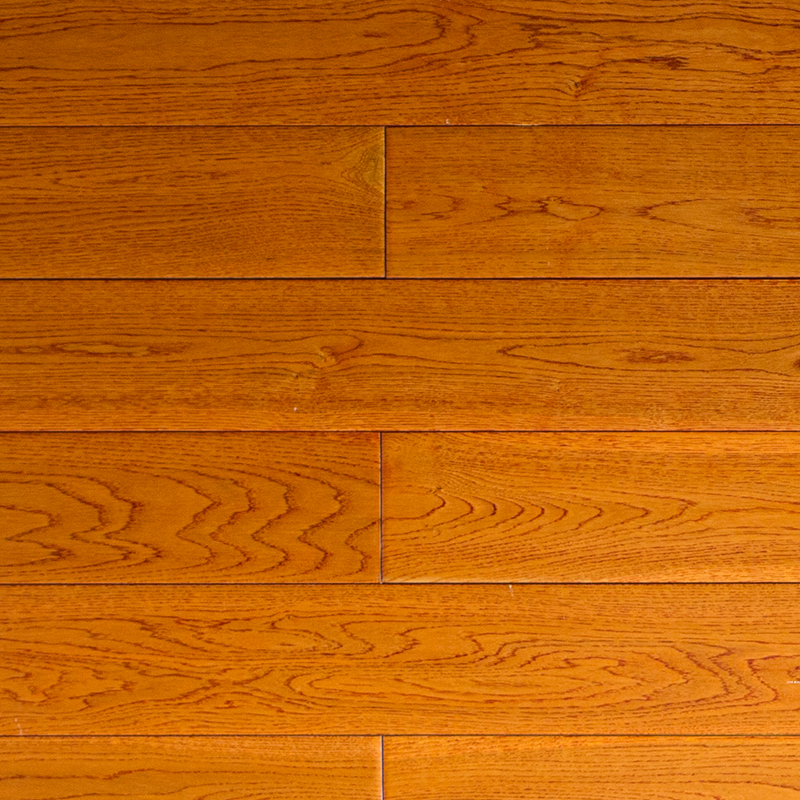
Solid wood flooring is a flooring product milled from a single piece of hardwood, typically 18 to 20mm thick, with no plywood or composite core beneath the surface. Unlike engineered flooring, every millimeter of a solid plank is the same species, which means it can be sanded and refinished repeatedly over its service life. This structural depth is what allows properly maintained solid wood flooring to remain in service for well over 60 years in commercial buildings.
7-10x Refinishing cycles over a plank's lifetime
1,360 Janka hardness rating of white oak
18-20mm Typical full-thickness plank depth
Key Benefits of Solid Wood Flooring
Solid wood flooring delivers three advantages that composite alternatives cannot fully replicate: refinishing depth, natural grain consistency, and long-term resale value.
- Full-depth wear layer. Because the plank is solid hardwood, it can be sanded down and refinished multiple times, restoring the surface instead of requiring replacement.
- Consistent grain and color. A single-species plank ages and patinas evenly, without the veneer-mismatch issues that can appear on engineered products over decades.
- Higher resale value. Real estate appraisers consistently treat solid hardwood as a value-adding feature, unlike laminate or vinyl alternatives.
- Repairability. Individual boards can be replaced or re-sanded locally without disturbing the surrounding floor.
Solid Wood Flooring vs Engineered Wood Flooring
The right choice depends on subfloor conditions, humidity exposure, and how long the building owner plans to hold the property.
Solid Wood Flooring
- Full hardwood thickness, refinishable many times
- Best above-grade, on wood subfloors
- More sensitive to humidity swings
- Longer usable lifespan with care
Engineered Wood Flooring
- Plywood core with a hardwood veneer top
- Works on concrete slabs and below-grade rooms
- More dimensionally stable in humid climates
- Fewer refinishing cycles before veneer is exhausted
Best Applications for Solid Wood Flooring
Solid wood flooring performs best in climate-controlled, above-grade spaces where long-term durability outweighs installation flexibility.
| Application |
Why Solid Wood Fits |
| Hotel guest floors |
High foot traffic offset by periodic refinishing rather than replacement |
| Executive offices |
Premium appearance supports brand and workspace value |
| Private residences |
Long ownership horizon justifies the refinishing investment |
| Retail showrooms |
Natural grain reinforces a premium product environment |
How Solid Wood Flooring Is Manufactured
Manufacturing quality determines how well a plank resists warping after installation, making the production process worth understanding before ordering.
- Species selection and grading. Logs are sorted by grain pattern and structural integrity.
- Kiln drying. Moisture content is reduced to a stable range to prevent post-installation shrinkage.
- Milling and profiling. Boards are cut to thickness and machined with tongue-and-groove edges.
- Sanding. Surfaces are progressively sanded to a uniform, paint-ready finish.
- Coating. Protective finish is applied to resist scratching and moisture.
- Inspection and grading. Each plank is checked for dimensional accuracy before packing.
How to Choose the Right Solid Wood Flooring Supplier
A reliable solid wood flooring supplier should provide kiln-drying documentation, a formaldehyde emission report, and sample boards for on-site acclimation testing before a full order ships. Suppliers who cannot produce moisture-content data on request are the leading cause of post-installation warping claims.
Beyond documentation, evaluate a supplier's production capacity, custom milling capability, and whether they support project-based orders for multi-room or multi-building installations.
Frequently Asked Questions
How long does solid wood flooring last?
With periodic refinishing, solid wood flooring commonly lasts 60 to 100 years in above-grade interior spaces, far outlasting laminate or vinyl alternatives.
Can solid wood flooring be installed over concrete?
Not directly. Solid wood flooring requires a wood subfloor or a properly built floating subfloor system, since direct contact with concrete introduces excess moisture risk.
How many times can solid wood flooring be refinished?
A standard 18-20mm plank can typically be sanded and refinished 7 to 10 times over its lifetime, depending on how much material each sanding removes.
Is solid wood flooring more expensive than engineered wood?
Solid wood flooring generally has a higher upfront material cost, but its longer refinishing lifespan often lowers the total cost of ownership over a multi-decade horizon.



 English
 Español
 عربى
عربى
 Get Free Sample