


 English
 Español
 عربى
عربى
Get Social
Choose DEIF for the perfect blend of
performance and aesthetics.
 Get Free Sample

Content
Walnut has been used in fine furniture and flooring for centuries because of its rich color depth and workability, but durability is the question most homeowners actually care about before they commit to a floor that has to survive foot traffic, furniture, pets, and daily life. American walnut flooring sits in a specific place on the hardness spectrum: softer than oak or hickory, but perfectly serviceable for most residential settings when installed and maintained correctly.
Durability in wood flooring is not a single number. It is a combination of hardness, finish quality, board construction, subfloor conditions, and how a household actually uses the space. This guide breaks each of those factors down so you can judge whether walnut fits your lifestyle rather than relying on marketing claims.
The Janka hardness test measures the force required to embed a steel ball halfway into a wood sample. It is the industry standard for comparing wood species and gives a useful, though not complete, picture of scratch and dent resistance.
| Wood Species | Janka Rating (lbf) | Relative Hardness |
|---|---|---|
| American Black Walnut | 1,010 | Medium |
| Red Oak | 1,290 | Medium-High |
| White Oak | 1,360 | High |
| Hickory | 1,820 | Very High |
| Brazilian Walnut (Ipe) | 3,680 | Extreme |
| European Walnut | 1,220 | Medium-High |
American walnut ranks softer than oak but firmer than pine or fir. It is not the toughest option on the market, but it holds up well in low-to-moderate traffic areas such as bedrooms, formal living rooms, and offices. Brazilian walnut, despite the shared name, is a botanically different species with dramatically higher hardness, making it a common choice for high-traffic commercial spaces or exterior decking applications.
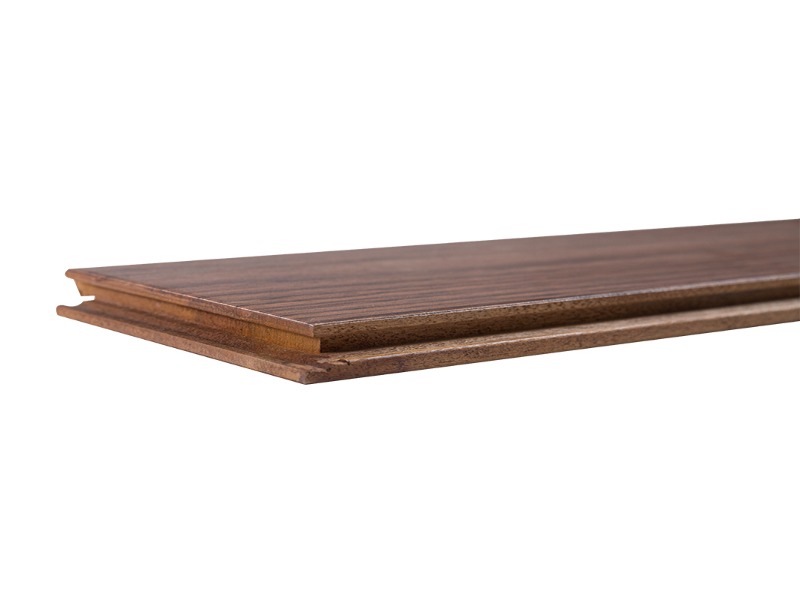
Construction type affects long-term durability just as much as species hardness. Neither option is universally superior; the right choice depends on subfloor type, humidity levels, and renovation plans.
For homeowners asking whether solid or engineered walnut is better, the practical answer is that engineered construction offers superior dimensional durability in variable climates, while solid boards offer a longer refinishing lifespan in stable environments.
Grading affects visual consistency, not structural strength. Understanding grades helps set realistic expectations for how a floor will look as it ages.
| Grade | Characteristics | Best Use Case |
|---|---|---|
| Select and Better | Minimal knots, consistent color, fewer sapwood streaks | Formal spaces, uniform aesthetic |
| Character Grade | Natural knots, mineral streaks, color variation | Rustic interiors, better at hiding wear marks |
Character grade walnut flooring often performs better in busy households because the natural variation camouflages minor scuffs and dents more effectively than a uniform, high-grade surface.
Because walnut sits at a medium Janka rating, it is more prone to dents from dropped objects, high heels, and heavy furniture than harder species. This does not make it unsuitable for most homes, but it does mean certain precautions matter more.
Mapping wear zones before installation helps decide where to add rugs, mats, or upgraded finish coats, extending the practical lifespan of the floor without changing the wood species itself.
Households with large, active dogs should expect visible claw marks over time on any medium-hardness species, walnut included. Matte or satin finishes with added scratch-resistant coatings help minimize this, and character grade boards hide marks more effectively than clear grade.
Walnut, like nearly all hardwoods, is not designed for standing water or consistently damp environments. Spills should be wiped promptly. Engineered walnut with a stable core and proper sealing performs better in semi-humid areas such as basements, though full bathrooms and laundry rooms remain poor candidates for any wood flooring.
| Item | Typical Price Range (per square foot) |
|---|---|
| Material only, solid walnut | 8 to 14 USD |
| Material only, engineered walnut | 6 to 11 USD |
| Professional installation labor | 3 to 8 USD |
| Refinishing (sand and recoat) | 3 to 5 USD |
Professional installation is strongly recommended for solid walnut, since improper acclimation or nailing patterns can lead to premature gapping or cupping. Engineered walnut floating floors are more forgiving for experienced DIY installers, though a professional moisture test of the subfloor is still advisable before starting.
Most walnut floors benefit from a light screen-and-recoat every three to five years in moderate traffic homes, with a full sand-and-refinish needed roughly every eight to twelve years depending on wear.
| Option | Durability Impact |
|---|---|
| Smooth finish | Shows scratches more visibly, easier to clean |
| Wire-brushed texture | Hides minor surface marks, adds tactile grain definition |
| Herringbone pattern | No inherent durability change, but requires more precise installation to prevent gapping at angled joints |
Walnut works well for moderate-traffic family spaces such as bedrooms, dining rooms, and living rooms. For very high-traffic zones with heavy foot traffic or large pets, area rugs and protective finishes are recommended to offset its medium hardness rating.
Walnut is more prone to denting than oak or hickory due to its lower Janka rating, but everyday dents from typical household use are uncommon when furniture pads and entry mats are used consistently.
Yes, walnut is more photosensitive than many other wood species and can lighten or shift tone with prolonged direct sun exposure. Rotating rugs periodically and using UV-filtering window treatments helps maintain even coloring.
Natural walnut tends to lighten slightly with age and UV exposure, while some other species darken. This is a normal characteristic of the wood's natural oxidation process rather than a defect.
Walnut is a renewable material, and choosing boards certified by responsible forestry programs supports sustainable sourcing. Engineered walnut also uses less face-grade material per square foot than solid boards, reducing raw material demand.
Solid walnut offers a longer refinishing lifespan in stable, climate-controlled homes, while engineered walnut provides better dimensional stability for basements, radiant heat systems, and variable humidity climates.

We provide customers with sustainable and eco-friendly
engineered wood solutions and services.
Choose DEIF for the perfect blend of
performance and aesthetics.
