


 English
 Español
 عربى
عربى
Get Social
Choose DEIF for the perfect blend of
performance and aesthetics.
 Get Free Sample

Content
Solid wood has a natural tendency to move. Every change in relative humidity causes the fibers to swell or shrink, and the wider the plank, the greater the cumulative movement across its face. A solid plank at 220 mm width can expand and contract by several millimeters across the seasons, which is enough to open gaps at the joints, cup the edges, or crack the surface. This is why the widest solid planks have traditionally been installed as narrow strips, or why they demand very stable interior conditions that most modern buildings simply cannot provide.
An engineered core changes that equation. By replacing a single thick piece of solid timber with a cross-laminated base, the floor absorbs moisture-driven movement internally instead of translating it to the surface. The result is a plank that can be produced at 180 mm, 220 mm, 260 mm, or even 300 mm and still hold its geometry through seasonal humidity swings. For specifiers working on large residential layouts, hotel corridors, or open commercial floors, this is the difference between a design that looks continuous for a decade and one that needs replacing within a few seasons.
The sections below examine the structural logic, the surface technology, the format advantages, the manufacturing controls, and the customization options that define modern wide plank engineered wood flooring. The focus is technical and practical, aimed at buyers, specifiers, and importers who need to evaluate the product on performance rather than marketing language.
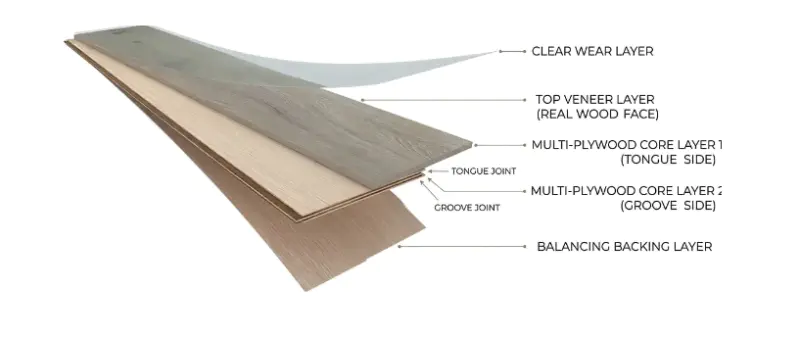
The stability of an engineered plank comes from the way its layers are arranged, not from the thickness of any single layer. A typical construction places a decorative hardwood veneer on top of a multi-ply substrate, where adjacent layers are oriented at right angles to one another. This cross-ply arrangement is the mechanism that controls movement.
Wood expands and contracts primarily along the grain direction, not across it. When a layer oriented along the length of the plank tries to expand, the layer beneath it, oriented across the width, resists that movement. The opposing forces cancel each other out at the panel scale, so the finished plank remains dimensionally stable even as individual layers respond to humidity. This is why a 3-layer or 7-layer engineered plank can be produced at large format without the cupping and gapping that would affect a solid plank of the same width.
| Attribute | 3-Layer Construction | 7-Layer Construction |
|---|---|---|
| Core layers | 3 | 7 |
| Typical total thickness | 12-15 mm | 15-21 mm |
| Dimensional stability | High | Very high |
| Underfloor heating suitability | Good | Excellent |
| Best suited to | Residential, light commercial | Large format, heavy commercial, hospitality |
| Refinishing potential | 1-2 times | 2-3 times |
The choice between a 3-layer and a 7-layer core is not about quality in absolute terms. It is about matching the core to the format and the service conditions. A 7-layer core distributes internal stress across more interfaces, which is why it is the preferred substrate for planks wider than 220 mm and for installations over underfloor heating, where temperature cycling adds another dimension of movement.
In a controlled test environment, a well-made engineered plank can remain stable across a relative humidity range of roughly 35 percent to 75 percent. This range covers the vast majority of heated and air-conditioned interiors. Outside that range, all wood products will eventually respond, but the cross-ply structure delays and reduces the visible effect. The practical outcome is that a wide plank floor installed in a normal building will not develop the seasonal gaps that a solid floor of the same width would show.
The surface of a wide plank floor takes the wear, the light, and the cleaning chemicals. A finish system that is too thin will wear through at traffic points; one that is too brittle will crack as the plank moves; one that is too soft will show scratches from grit and furniture. The coating system therefore has to balance hardness, flexibility, and clarity.
Each layer in the system has a function. The base layers bond to the veneer and provide flexibility. The intermediate layers build thickness and hardness. The top layers control gloss level, surface tension, and resistance to household chemicals. Curing is done with ultraviolet light between coats, which allows the manufacturer to control the degree of cross-linking and avoid the long drying times associated with solvent-based finishes.
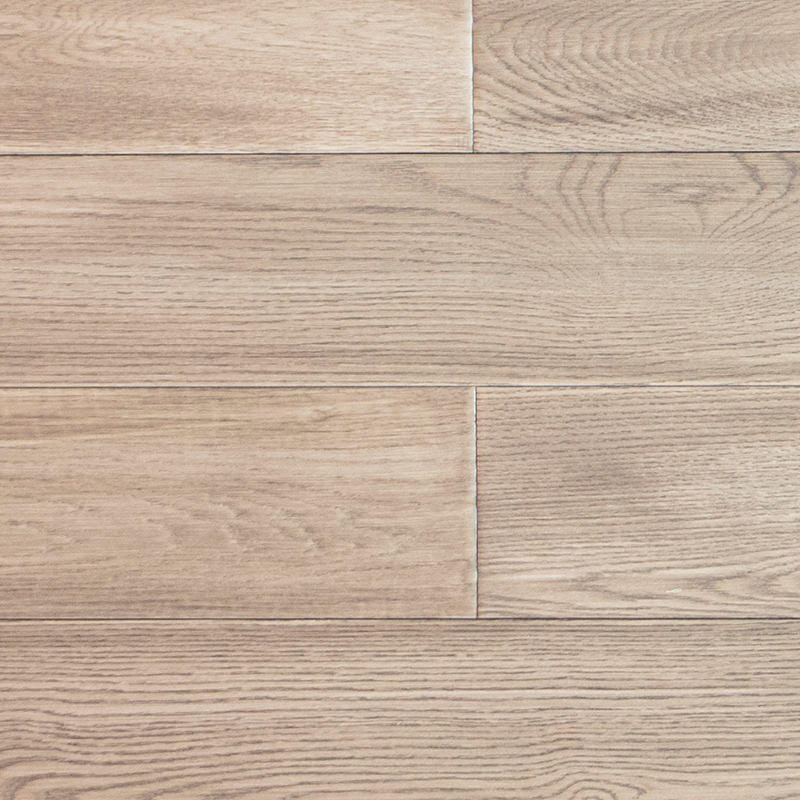
Beyond the coating, the surface can be mechanically or thermally treated to change its appearance and feel. Brushing opens the softer grain and creates a subtle texture. Hand scraping produces irregular, artisan-like surface variation. Smoking darkens the wood through a controlled reaction rather than a pigment, so the color runs deeper than a surface stain. These treatments are applied before coating and are compatible with the 7-layer UV system.
Width is not only an aesthetic decision. It changes how a floor performs visually, how it is installed, and how it interacts with the room around it.
A 180 mm plank and a 260 mm plank cover the same floor area with a different number of joints. Fewer joints mean fewer interruptions to the grain pattern and a stronger sense of a single continuous surface. In large rooms, this effect is pronounced: the floor reads as one field rather than a collection of narrow strips. For open-plan living areas, hotel lobbies, and retail floors, this visual continuity is often the primary reason for choosing a wide format.
Wide planks accept a broader range of finishes without looking busy. A wide brushed plank in a pale tone can carry a minimalist interior; a hand-scraped wide plank in a deep tone can anchor a more traditional or hospitality scheme. Because the format is large, color variation between planks becomes a design feature rather than a distraction, provided the grading is controlled.
Wide planks cover more area per unit, so the number of pieces handled and the number of joints closed is lower than with narrow strips. When the plank is profiled with a click lock system, installation does not require adhesive across the field, which reduces labor time and allows the floor to be walked on sooner. The tighter joints also reduce the number of gaps where dust and spills can collect.
| Plank Width | Relative Joint Density | Typical Application |
|---|---|---|
| 120-150 mm | High | Traditional residential |
| 180-200 mm | Medium | Modern residential, light commercial |
| 220-260 mm | Low | Large residential, hospitality |
| 280-300 mm | Very low | Feature floors, commercial lobbies |
A wide plank is less forgiving of manufacturing variation than a narrow one. A small deviation in layer thickness or moisture content that would be invisible in a 120 mm plank can become a visible crown or cup across a 260 mm face. Production controls therefore matter more as width increases.
Veneer, core layers, and backing are conditioned to a target moisture content before assembly. If the layers are assembled at different moisture levels, the finished plank will move as they equalize, and the movement will show as distortion. Inline moisture measurement at the gluing stage is a practical way to catch this before pressing.
The cross-ply orientation only works if the layers are actually aligned at the intended angle. Automated lay-up and controlled press pressure keep the layers flat and the grain directions correct. After pressing, panels are acclimatized before profiling, which allows residual stress to settle and reduces the chance of movement after machining.
The tongue-and-groove or click profile must be cut to tight tolerance along the full length of a wide plank. If the profile varies, the joints will not close evenly, and the floor will show gaps or lippage. CNC profiling with regular tool checks keeps the joint geometry consistent across a production run.
Standard ranges cover common widths and finishes, but many projects require a specific combination of format, surface, and packaging. A manufacturer that can customize at the production stage gives importers and brand owners more control over their offer.
For distributors and brand owners, OEM production covers the plank itself plus the packaging and labeling that carry the brand. This includes custom carton design, printed installation instructions, and private label branding on the product. The manufacturer produces to the buyer's specification, and the buyer controls the market positioning.
International buyers need documentation as much as product. Certifications such as CE, FSC, and CARB are commonly requested, and they cover structural performance, responsible sourcing, and formaldehyde emission limits respectively. A supplier that holds these certificates and can issue the corresponding documents reduces the risk of customs delays and project rejection.
Standard production lead time for regular orders is typically 15 to 20 days after confirmation of specifications and deposit. Custom colors or new profiles may require additional sampling time. For urgent projects, expedited production can be arranged subject to capacity and material availability. Clear communication of the specification freeze date is the single most effective way to keep a project on schedule.
Wide plank formats generally start at 180 mm and run to 300 mm or more, depending on the core construction. Widths of 180 mm to 260 mm are the most common for residential and hospitality projects, while 280 mm to 300 mm is used for feature floors and large commercial spaces.
Yes, when the core is designed for it. A multi-ply cross-laminated core distributes heat-induced movement internally and is less likely to cup or gap than a solid plank. A 7-layer core is generally preferred for underfloor heating because it handles temperature cycling more predictably. Installation should follow the heating system manufacturer's ramp-up schedule.
The difference is the number of cross-laminated core layers and the total thickness. A 3-layer core is thinner, lighter, and suitable for most residential and light commercial floors. A 7-layer core is thicker, more stable under wide formats and temperature variation, and better suited to heavy commercial use and underfloor heating.
Yes, provided the decorative veneer is thick enough. A typical refinishing removes a small amount of surface material, so the number of times a floor can be refinished depends on the veneer thickness. Thicker veneers allow two or three refinishing cycles over the life of the floor.
Yes. Custom color matching, surface texture, width, length, thickness, and packaging are available for OEM and private label orders. The usual process is to approve a physical sample before full production, which confirms the color, gloss, and texture against the target specification.
The cross-ply core offsets moisture-driven movement, so the plank remains stable across a relative humidity range of roughly 35 percent to 75 percent. Maintaining indoor humidity within that range supports the long-term performance of any wood floor, engineered or solid.

We provide customers with sustainable and eco-friendly
engineered wood solutions and services.
Choose DEIF for the perfect blend of
performance and aesthetics.
