


 English
 Español
 عربى




Get Social
Choose DEIF for the perfect blend of
performance and aesthetics.
 Get Free Sample

Content
Buyers who source from a commercial wood flooring supplier for a hotel, office tower or retail renovation often discover the same problems too late. A certificate turns out to cover a different product line. Batch colors drift between the sample room and the delivered pallets. A container is held at the port because the species declaration does not match the paperwork. The schedule slips by six weeks because the company that quoted the price was really a trading intermediary waiting on a subcontractor.
These failures share a root cause: the buyer evaluated the quotation rather than the production system behind it. A commercial wood flooring supplier should be judged on its factory capability, its documentation, its capacity to repeat the same result across many batches, and its commercial terms. This guide offers a structured way to compare suppliers before committing volume. It is written for importers, distributors, general contractors, hotel developers and architects who need a defensible internal decision.
The sections below move from the basic question of who actually makes the product, through certification, capacity, commercial terms and after-sales support. The guide closes with a checklist that can be copied directly into internal review documents.
Key principle: evaluate the production system, not only the sample board. A good sample proves what a factory can do once; a good system proves it can do the same thing on the fortieth batch.
Many buyers assume that any company with a factory address is a manufacturer. In practice, a large share of export offers come from trading companies that source from several workshops. Trading companies can be useful partners, but they change the risk profile. Quality control depends on a subcontractor, lead times depend on someone else's schedule, and customization requests can be lost between layers of communication.
The table below summarizes five checks that can be completed during a video call or a site visit.
| Check Item | Production-Based Manufacturer | Trading Company |
|---|---|---|
| Production equipment | Own automated lines, including CNC machining and sanding | Outsources all production |
| Capacity data | Stated monthly and annual output with supporting records | Vague or no concrete capacity figures |
| Quality control | In-house moisture testing and batch inspection | Relies on the subcontractor's QC |
| Sample turnaround | Samples made in house, often within about one week | Samples forwarded from another workshop |
| Certificates | Certificates issued in the factory's own name | Certificates belonging to other producers |
None of these checks is decisive alone, but a supplier that fails three or more should be treated with caution for projects above a few thousand square meters. The cost of a mistake at that scale is far greater than the saving on unit price.
Certification is where many imports stall. Architects need documents for permit submissions, customs officers check material declarations, and building owners increasingly ask for indoor air quality data. The right certificate depends on the destination market and the project type, so the first step is to define exactly where the material will be installed and which authority will review it.
A common trap is a supplier who states that its products meet international standards without naming the certificate holder. Request copies of the certificates themselves, check that the company name and product description match the offer, and confirm validity dates with the issuing body where possible.
Species declarations should match the Latin name printed on the product and the species stated in the export documents. Suppliers that work with common commercial species such as oak, ash and black locust, backed by clear origin records, reduce the risk of delays linked to CITES restrictions. Ask for a species list and a sample origin declaration before placing any order, and keep these documents with the project file.
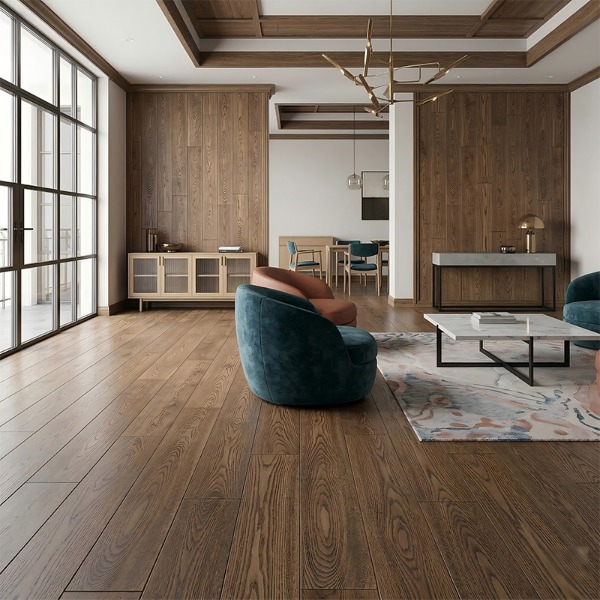
A commercial project is not a single shipment. It may require several thousand square meters delivered in staged batches over several months, with every batch matching the approved sample. A supplier can produce excellent prototypes and still be unable to hold color, dimension and surface finish across a large order. Capacity and quality control must be evaluated together.
Ask for stable monthly output rather than peak capacity. The useful question is whether the factory can reserve a production window for your project, complete it in stages, and still accept other orders without repeated delays. Request a sample production schedule for an order of comparable size, and check whether the timeline includes buffer days for drying and inspection.
Moisture content is one of the most important technical parameters for commercial flooring, especially where it is installed over underfloor heating or in climate-controlled buildings. Many commercial specifications target a moisture range of roughly 8 to 10 percent, adjusted for the installation climate. Dimensional tolerances should be stated in writing, because small variations in thickness or width create visible gaps and uneven joints across large floor areas.
A dependable factory applies quality checks at each stage rather than only at the end. The following checkpoints are a reasonable baseline for commercial orders.
Commercial terms determine whether a supplier relationship can be managed smoothly. Importers need to test the market with a limited trial. Project teams often need custom sizes, private-label packaging or a particular surface finish. Each of these requests should be clarified before the contract is signed, because a verbal promise rarely survives a delayed shipment.
| Term | What to Confirm | Why It Matters |
|---|---|---|
| Minimum order quantity | MOQ for standard designs, often starting around 1,000 square meters | Sets the entry cost for distributors and small contractors |
| Trial order | Whether a smaller test order is accepted, sometimes around 500 square meters at a higher unit price | Lets buyers test quality and market response |
| Standard lead time | Production window after deposit, commonly 20 to 25 days | Determines whether the schedule fits the site plan |
| Custom lead time | Longer window for special sizes or finishes, commonly 25 to 30 days | Custom work should be planned separately |
| Sample policy | Sample fee, shipping cost and refund rule after a production order | Avoids unexpected costs during approval |
OEM and ODM arrangements are common in this sector, but their scope varies widely. Ask the supplier to list both what it can produce and what it cannot. Typical requests include:
Any request that falls outside the validated range should be treated as a development project, with its own sample approval and timeline.
Clarify who pays for samples, whether sample fees are refunded after a production order, and whether the sample is made on the same production line as the bulk order. Samples made on a different line or by hand rarely predict bulk performance. A sample approved on the actual production line gives the buyer far more confidence before a large commitment.
Commercial projects are governed by different expectations than residential homes. Foot traffic is heavier, furniture is moved more frequently, cleaning routines are more aggressive, and the building may be operated for many years under continuous use. The warranty and support terms should reflect that reality.
Many suppliers advertise long residential warranties while quietly excluding commercial traffic. A commercial warranty is often shorter, commonly around five years for commercial use, while residential terms can extend to ten years. Read the exclusion clauses carefully and confirm in writing whether the warranty explicitly covers commercial occupancy, the wear class of the surface and the claim procedure.
A complete export package should be agreed before production begins. Typical documents include:
Technical support is often overlooked until a problem appears on site. Clarify the following points before signing:
The evaluation process works best as a sequence of gates. A supplier that fails an early gate should not progress to sample approval, however attractive its price may look. Gates protect the project from the most expensive mistakes, which usually appear after the deposit has been paid.
Passing the first two gates confirms that the supplier is a real manufacturer with valid documentation. The capacity audit then tests whether it can deliver the volume. Trade terms and warranty come last, but they should be reviewed before any deposit, not after the first batch has arrived.
Copy the list below into your internal review document. A supplier that cannot answer at least eight of the ten items in writing should be reconsidered before samples are approved.
Ask the supplier to describe its production equipment, show the machining sequence and explain its quality checks in detail. A manufacturer can usually answer these questions directly and can arrange a video walkthrough of the production floor. Trading companies tend to give general answers or redirect questions to a partner workshop.
The core certificates overlap, but commercial projects more often require documentation for permit submissions, indoor air quality programs and public tenders. Architects may also specify wear class and fire performance. Confirm the requirements with the project's design team before ordering.
Not necessarily. A very cheap sample may be produced on a different line, by hand or from a different batch of timber. Judge the sample by how closely it reflects the production process, and check whether the sample fee is refunded when a production order follows.
Require a retained reference board, a defined color tolerance agreed in writing, and batch-level inspection records before each shipment. Dimensional tolerances and moisture ranges should also be recorded per batch so that any variation can be traced and addressed.
Custom work often requires new tooling, separate sample approval and changes to the production schedule. Each of these steps adds time. Buyers who plan custom requirements early in the project can usually keep the schedule within an acceptable range.
A trial order is a practical way to test quality, packaging, documentation and communication before committing to a long-term contract. Even if the unit price is higher, a limited trial can prevent much larger losses on a full-volume order that does not meet expectations.
Choosing a commercial wood flooring supplier is a risk management exercise as much as a purchasing decision. The lowest quotation rarely reflects the full cost once certification gaps, delayed batches, rework and warranty disputes are included. A supplier that performs well across factory verification, compliance, capacity, commercial terms and after-sales support is far more likely to deliver a project on time and within specification.
Use the checklist in this guide to compare at least three candidates side by side, request written answers to the same questions from each, and review documentation before approving samples. Where possible, ask for references from comparable hotel, office or retail projects and speak directly with those clients. When the shortlist is narrowed, arrange a factory visit or a live production review to confirm what the paperwork describes.

We provide customers with sustainable and eco-friendly
engineered wood solutions and services.
Choose DEIF for the perfect blend of
performance and aesthetics.
